
The Death of the “Digital” Marketer: Why Human-Centric Strategy is the Only Way Forward in 2026.
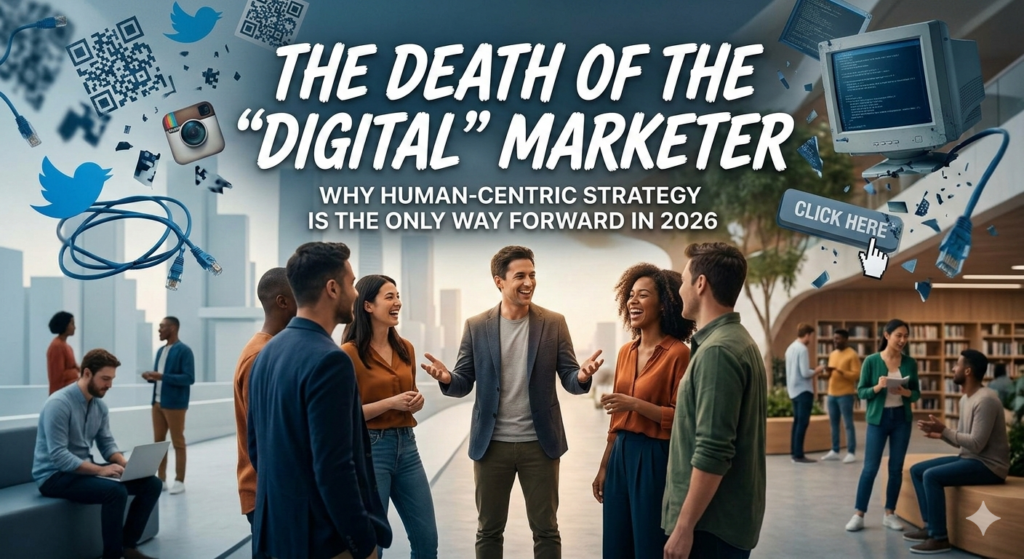
For decades, we’ve separated “Marketing” and “Digital Marketing.” We’ve treated the digital space like a separate laboratory where we could poke buttons, manipulate algorithms, and expect a predictable result.
But as we sit here in 2026, the curtain has been pulled back. The “hacks” are dead. The “cheat codes” have been patched. We are entering an era where the most successful digital marketers are the ones who realize that the tech is invisible, but the psychology is eternal.
1. The Great Algorithm Fatigue
We’ve all felt it. The relentless chase of the TikTok “hooks,” the obsession with Instagram’s latest feature, and the desperate attempt to keep up with Google’s weekly core updates.
The reality? The platforms have become too smart for your tricks.
Modern AI-driven algorithms no longer prioritize just “engagement” (which led to the era of clickbait). They prioritize Retention and Satisfaction. They can tell if a user actually found value in your content or if they just clicked and bounced. This shift means that the “Digital” part of marketing is now just the plumbing—the “Marketing” part (the storytelling, the empathy, the value) is the actual water.
2. The Rise of "Zero-Click" Content
One of the most radical shifts in the last 24 months has been the rise of Zero-Click Marketing. Platforms like LinkedIn, X, and even Google want to keep users on their platform. If your entire strategy is “Link in Bio” or “Click here to read more,” you are fighting a losing battle against the platform’s own interests.
The Strategy: Give away the “Gold” in the post itself.
Don’t tell them you have a solution; show them the solution.
Provide the takeaway in the first three sentences.
If you provide enough value upfront, the user will eventually seek you out on their own terms. That is high-intent traffic, which is worth 10x more than a “curiosity click.”
3. The "Post-Search" Reality: From SEO to AIO
Search Engine Optimization (SEO) isn’t dying, but it is evolving into AIO (AI Optimization). With the proliferation of LLMs (Large Language Models), people aren’t just typing “best running shoes” into a search bar. They are asking AI: “I have flat feet and I run on gravel—what shoes should I buy?”
To win in this landscape, your content can’t just be a list of keywords. It needs to be Authoritative, Nuanced, and Experience-based. AI models pull from sources that demonstrate “E-E-A-T” (Experience, Expertise, Authoritativeness, and Trustworthiness). If your content looks like it was written by a bot for a bot, it will be ignored by both.
4. Community is the New Moat
If you sell a generic product, AI will eventually find a cheaper, faster version for your customer. You cannot compete on features or price in an AI-optimized marketplace. Your only “moat” (defensible advantage) is Community.
Communities are groups of people who talk to each other because of you. Whether it’s a Discord for software power users or a local running club for a shoe brand, these human connections cannot be replicated by an algorithm.
Shift in Focus: Stop trying to reach a million strangers. Focus on the “1,000 True Fans” philosophy. In 2026, a brand with 500 hyper-engaged community members is more stable than a brand with 500,000 passive followers.
5. The Return of the "Big Idea"
For years, digital marketing became “Performance Marketing”—a game of spreadsheets and micro-optimizations. We stopped asking “Is this a great idea?” and started asking “What is the Cost Per Click?”
But when AI handles the CPC, the human marketer is free to return to the Big Idea. Creative strategy is the ultimate lever. One brilliant, culturally-relevant campaign (think modern versions of the “Dumb Ways to Die” or “Dove Real Beauty” campaigns) will always outperform a thousand “optimized” AI ads. In 2026, we are seeing a renaissance of creative directors and storytellers who can tap into the collective human psyche.
The Final Verdict
Digital marketing is no longer about “the digital.” The tools are invisible. The platforms are automated. The only thing that remains variable is the human connection. Stop trying to beat the machines at being a machine. They are faster, they don’t sleep, and they don’t make math errors. Instead, be the thing they can never be: Contextual, empathetic, and remarkably human. The brands that win in 2026 won’t be the ones with the best AI—everyone has that. They will be the ones who use that AI to free up their humans to do what humans do best: Create, Connect, and Care.
