
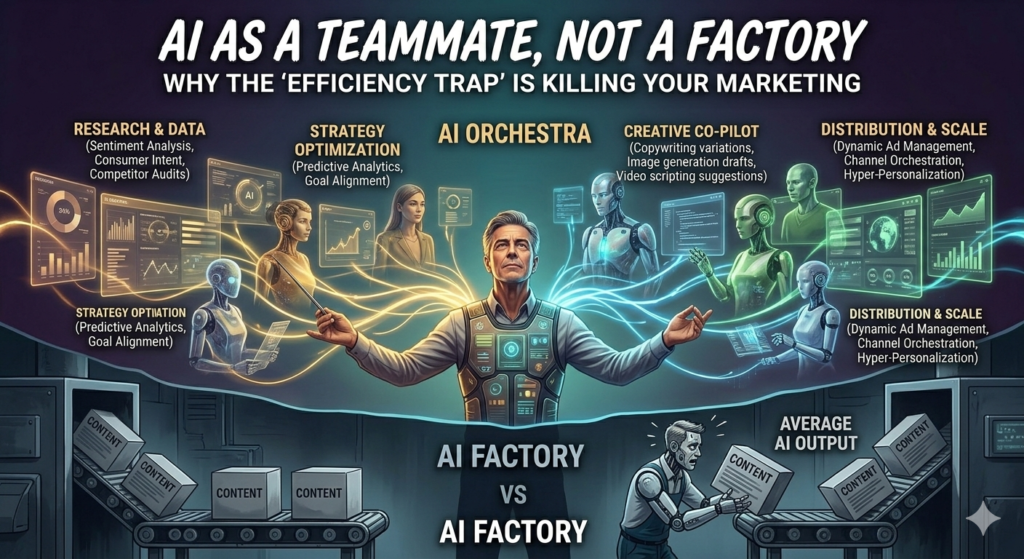
In the last three years, the world has undergone a content explosion. Since the democratization of generative AI, the barrier to “creating” has vanished. Need a 2,000-word whitepaper? Two seconds. Need 50 social media captions? Three seconds. Need a high-definition brand image? Five seconds.
Most businesses looked at this and saw a Factory. They saw a way to replace expensive humans with infinite, free “output.” They flooded the internet with AI-generated blogs, AI-voiced videos, and AI-templated strategies.
But here is the hard truth of 2026: The more you use AI as a factory, the less your audience cares. In an era of infinite volume, the “Factory” approach has led to the “Efficiency Trap”—you are producing more content than ever, but it is moving the needle less than ever.
The winners of this era have realized that AI isn’t the assembly line; it’s the Teammate.
1. The Commodity of "Correctness"
AI is incredibly good at being “correct.” It can follow grammatical rules perfectly. It can summarize data without error. It can follow a brand voice guide to the letter.
However, in marketing, “Correct” is the bare minimum. Correctness doesn’t stop a scroll. Correctness doesn’t build a movement. Correctness doesn’t make someone choose your $5,000 service over a competitor’s $500 service.
When you treat AI as a factory, you are producing commodity content. When you treat it as a teammate, you use it to handle the “correctness” so you can focus on the Dissonance. In 2026, marketing that works is the marketing that breaks the pattern, offers a surprising opinion, or shares a vulnerable human truth.
2. The 70/30 Rule of Creative Orchestration
The most successful marketing teams in 2026 operate on a 70/30 split.
The 70% (The AI Teammate): This is the heavy lifting. The AI handles research, sentiment analysis, initial drafting, formatting, SEO metadata, and data visualization. It’s the world’s best research assistant and junior copywriter.
The 30% (The Human Lead): This is the “Soul.” It’s the hook that only a human could write because it references a shared cultural moment. It’s the specific case study that isn’t in any database. It’s the “vibe check” that ensures the content doesn’t sound like a corporate manual.
If you let the AI do 100%, you have a factory. If you do 100% yourself, you are working too hard. The magic happens in the handoff.
3. Delegation vs. Abdication
The biggest mistake leaders make is abdicating their strategy to AI. They ask the tool, “What should my marketing strategy be for Q3?”
An AI teammate can give you a list of tactics, but it cannot give you a strategy. Strategy requires an understanding of nuance, market timing, and human intuition that models simply don’t possess.
Abdication: Letting the AI choose your brand’s tone and direction.
Delegation: Telling the AI, “Here is our specific brand philosophy and our unique perspective on this industry problem. Now, help me brainstorm 10 ways to visualize this for a LinkedIn carousel.”
4. The Rise of the "AI Architect"
The job description of the “Digital Marketer” has officially evolved into the AI Architect. In 2026, your value isn’t in your ability to write a post; it’s in your ability to prompt, pivot, and polish. 1. Prompting: Giving the teammate the context it needs to be useful. 2. Pivoting: Recognizing when the AI is hallucinating or being “too safe” and steering it in a more human direction. 3. Polishing: Adding the 10% of “Human Magic” at the end—the personal anecdote, the witty remark, or the counter-intuitive insight.
5. Fighting the "Algorithm of Average"
AI models are trained on the “average” of the internet. Therefore, by definition, the output of an AI factory is Average. If you want to be a market leader, “Average” is your enemy. An AI teammate is a tool to help you reach “Average” faster so that you have more time and energy to reach for “Exceptional.” Use AI to:
Summarize 50 customer reviews to find a common pain point.
Generate 20 different headlines so you can find the one that feels truly unique.
Turn a long-form transcript into a structured outline.
Then, take that outline and infuse it with your own blood, sweat, and tears. That is how you win.
Conclusion: The Machines are Here to Free You
The “Death of the Digital Marketer” isn’t a tragedy; it’s an invitation.
We are being freed from the drudgery of the assembly line. We no longer have to spend 4 hours a day on keyword research or formatting newsletters. We have been given a world-class teammate that works 24/7.
The question for 2026 isn’t “How much can you produce?” but “What can you create that a machine never could?”
Don’t build a factory. Build a partnership. Let the AI handle the “Digital,” and you handle the “Marketing.” The future belongs to those who use the machine to become more human, not less.