The “Invisible” Conversion
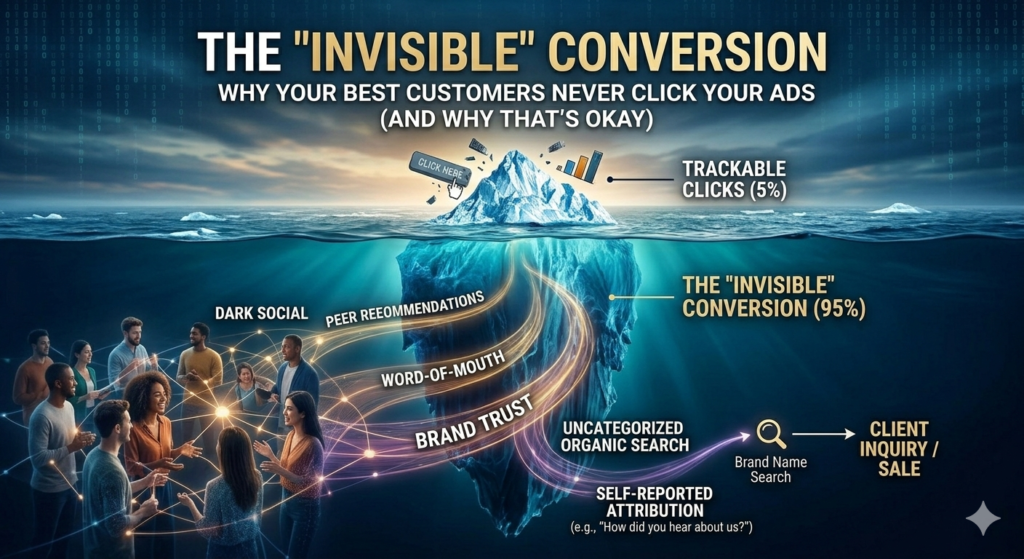
For years, the digital marketing world has been obsessed with a single metric: The Click. We’ve built entire careers, agencies, and software suites around the idea that if a user doesn’t click a link, the marketing failed. We’ve worshipped at the altar of Click-Through Rate (CTR) and Cost Per Click (CPC), believing that the “digital trail” is the only trail that matters.
But as we navigate the landscape of 2026, a quiet revolution has taken place. The most sophisticated buyers—the ones with the highest budgets and the longest loyalty—have stopped clicking.
Welcome to the era of The Invisible Conversion.
1. The Death of the Linear Attribution Model
Today, that model is a fantasy. A modern B2B buyer or a high-consideration B2C consumer follows a “messy middle” path that looks more like a spiderweb than a funnel:
They see your high-value post on LinkedIn while scrolling in bed. They don’t like or comment (they are “ghost followers”).
They hear your CEO interviewed on a podcast during their morning commute.
They see a screenshot of your product shared in a private Slack community or WhatsApp group.
They ask a GenAI tool (like Gemini or Perplexity), “What are the best solutions for [Problem X]?” and your brand is mentioned.
Two weeks later, they go to Google and type in your Brand Name directly.
The Result? Your dashboard tells you that “Organic Search” got the sale. Your paid social team looks like they failed because there were “0 clicks.” In reality, the social content did 90% of the work. This is the invisible conversion.
2. Dark Social: The Marketing Black Box
The term “Dark Social” refers to the social sharing of content that occurs outside of what can be measured by web analytics. This happens in private channels: DMs, emails, Slack, Discord, and even old-fashioned word-of-mouth.
In 2026, Dark Social is where the actual decisions are made. Why? Because we are living in a “Trust Crisis.” We don’t trust sponsored ads, and we barely trust “influencers.” We trust our peers. When someone shares your content into a private Slack channel with the message, “We should look into this,” that is a high-intent lead that no tracking pixel will ever see.
If you optimize your marketing only for what you can track, you will inevitably stop doing the things that actually build trust. You’ll stop making long-form educational videos (because the CTR is low) and start making annoying clickbait (because the CTR is high). You will “optimize” yourself into irrelevance.
3. Consumption Over Conversion
The biggest shift in human-centric strategy is prioritizing Consumption over Conversion. If a potential client watches 80% of your 10-minute video explaining a complex industry problem, that is a massive win. Even if they don’t click the “Book a Call” button immediately, you have successfully occupied “rent-free” space in their brain.
When that client finally has a “bleeding neck” problem that your company solves, who are they going to call? Not the person who showed them a “Buy Now” ad 50 times. They are going to call the person who educated them through their screen for the last six months.
Consumption is the leading indicator; Conversion is the lagging indicator.
4. How to Measure the Unmeasurable
If the conversion is invisible, how do you justify your marketing budget to the CEO? You have to change the metrics.
Self-Reported Attribution: This is the simplest and most powerful tool in 2026. Add a required, open-ended field to your contact forms: “How did you first hear about us?” You will be shocked to see “LinkedIn” or “A podcast” as the answer, even when the software says “Direct/Organic.”
Brand Search Volume: Monitor how many people are searching for your specific brand name on Google and YouTube. If your “untrackable” social content is working, your brand search volume will climb.
Direct Traffic Growth: An increase in people typing your URL directly into their browser is the ultimate sign of “Invisible” success.
5. The Content Strategy for Invisible Conversions
To win in this environment, your content must be Zero-Click Content. This means the value must be delivered in the platform.
Don’t say: “We have 5 tips for SEO on our blog. Link in bio!”
Do say: “Here are 5 tips for SEO. Tip 1 is… Tip 2 is…”
When you give the “Gold” away for free on the feed, you decrease your CTR but you increase your Authority. In a world of infinite noise, Authority is the only thing that scales.
Conclusion: Stop Counting, Start Connecting
The “Death of the Digital Marketer” (as we discussed in our previous post) is rooted in this shift. Machines can count clicks. Machines can optimize for 0.01% improvements in CTR.
But machines cannot build Salience. They cannot make a prospect feel, “These people truly understand my business.” The marketers who will dominate 2026 are those who have the courage to publish content that “fails” on a spreadsheet but “wins” in the mind of the consumer. They are the ones who understand that the most important path to purchase is the one that leaves no footprints.
Stop obsessing over the clicks you can see, and start obsessing over the value you provide when no one is watching.
